Showing posts with label poems. Show all posts

29 March 2012

RIP Adrienne Rich


Hearing early this morning the news of Adrienne Rich's death brought me immediately back to the blue skies and green expanses of grass and my best friend Karen and our earnest, blooming feminism beliefs. Humanism is what it's always been. And Rich, so gracefully, was a humanist poet. But it was always her love poems I loved best.

From 21 Love Poems


IV

I come home from you through the early light of spring
flashing off ordinary walls, the Pez Dorado,
the Discount Wares, the shoe-store… I’m lugging my sack
of groceries, I dash for the elevator
where a man, taut, elderly, carefully composed
lets the door almost close on me.—For god’s sake hold it!
I croak at him.—Hysterical,--he breathes my way.
I let myself into the kitchen, unload my bundles,
make coffee, open the window, put on Nina Simone
singing Here comes the sun… I open the mail,
drinking delicious coffee, delicious music,
my body still both light and heavy with you. The mail
lets fall a Xerox of something written by a man
aged 27, a hostage, tortured in prison:
My genitals have been the object of such a sadistic display
they keep me constantly awake with the pain…
Do whatever you can to survive.
You know, I think that men love wars…
And my incurable anger, my unmendable wounds
break open further with tears, I am crying helplessly,
and they still control the world, and you are not in my arms.


29 August 2011

The Seashell


Summer is ending. In Florida, that will mean October, for all intents and purposes. Nonetheless, I wrote a piece on bringing back the ocean to you wherever you are, by putting a seashell to your ear. Check it out right here on Art of Living. I also read at an open mic poetry event on Saturday. And I'll be reading at a bona fide event in a couple of weeks. I feel more alive than I have in years. Thank you, words.

02 May 2011

Let Love Be at The End


On September 11, 2001, my heart did not know what to do. After the shock, in Ms. magazine, I found it, a poem, when the war started, when our country unified then ripped apart, when the United States felt the quake of violence and yes, terror, known so well to most other countries, this poem brought me some peace. I want to say the peace has come with the fall of a frightening man, but for me, my heart is still aswirl in a sea of unrest. I know nothing but these words by Lucille Clifton, but I don't feel uplifted. This is just a wish.


LET THERE BE NEW FLOWERING

let there be new flowering
in the fields let the fields
turn mellow for the men
let the men keep tender
through the time let the time
be wrested from the war
let the war be won
let love be
at the end

{images by niko from visualmerc}

14 April 2011

We Need More Poetry--W.S. Merwin

"...poetry is what gives meaning to existence." -- V.V. Raman

W.S. Merwin has been publishing poetry since 1952. Tuesday, I picked up his 2009 Pulitzer Prize book of poems called The Shadow of Sirius, read the poem on the back cover, and wondered how I'd ever lived without his words.


Just This

When I think of the patience I have had
back in the dark before I remember
or knew it was night until the light came
all at once at the speed it was born to
with all the time in the world to fly through
not concerned about ever arriving
and then the gathering of the first stars
unhurried in their flowering spaces
and far into the story the planets
cooling slowly and the ages of rain
then the seas starting to bear memory
the gaze of the first cell at its waking
how did this haste begin this little time
at any time this reading by lightning
scarcely a word this nothing this heaven

25 February 2011

We Need More Poetry. This is Anne Sexton.


Anne Sexton is more than her suicide. She died the day I came into the world, and ever since I read "Her Kind," which mystified me at the time, I wanted to know more. So her words became a green and growing thing for me, a place of danger and fear and sadness and morbidity--beautiful places all, because of her words--sinuous, a strange tangle that somehow makes sense to the heart. I've read all her collections, keep the beautiful full collection close at hand, have read her daughter's biography. Her New England. Her beauty. Her fraught love for family--for her children, her beloved nana--those are my favorite poems of hers. She wrote her poems to keep the doctor informed, to keep him away. And in her confessionals came the kind of tenderness that holds, holds with a light grasp, the terrifying beauty of love. She is more. More than that single August day in 1974. She is the light I sometimes see by, one that shines on a glistening lake, a lake lapping at a boat. In the moonlight. On the way to Mercy Street, her old home.


45 Mercy Street

In my dream, 
drilling into the marrow 
of my entire bone, 
my real dream, 
I'm walking up and down Beacon Hill 
searching for a street sign - 
namely MERCY STREET. 
Not there. 

I try the Back Bay. 
Not there. 
Not there. 
And yet I know the number. 
45 Mercy Street. 
I know the stained-glass window 
of the foyer, 
the three flights of the house 
with its parquet floors. 
I know the furniture and 
mother, grandmother, great-grandmother, 
the servants. 
I know the cupboard of Spode 
the boat of ice, solid silver, 
where the butter sits in neat squares 
like strange giant's teeth 
on the big mahogany table. 
I know it well. 
Not there. 

Where did you go? 
45 Mercy Street, 
with great-grandmother 
kneeling in her whale-bone corset 
and praying gently but fiercely 
to the wash basin, 
at five A.M. 
at noon 
dozing in her wiggy rocker, 
grandfather taking a nap in the pantry, 
grandmother pushing the bell for the downstairs maid, 
and Nana rocking Mother with an oversized flower 
on her forehead to cover the curl 
of when she was good and when she was... 
And where she was begat 
and in a generation 
the third she will beget, 
me, 
with the stranger's seed blooming 
into the flower called Horrid. 

I walk in a yellow dress 
and a white pocketbook stuffed with cigarettes, 
enough pills, my wallet, my keys, 
and being twenty-eight, or is it forty-five? 
I walk. I walk. 
I hold matches at street signs 
for it is dark, 
as dark as the leathery dead 
and I have lost my green Ford, 
my house in the suburbs, 
two little kids 
sucked up like pollen by the bee in me 
and a husband 
who has wiped off his eyes 
in order not to see my inside out 
and I am walking and looking 
and this is no dream 
just my oily life 
where the people are alibis 
and the street is unfindable for an 
entire lifetime. 

Pull the shades down - 
I don't care! 
Bolt the door, mercy, 
erase the number, 
rip down the street sign, 
what can it matter, 
what can it matter to this cheapskate 
who wants to own the past 
that went out on a dead ship 
and left me only with paper? 

Not there. 

I open my pocketbook, 
as women do, 
and fish swim back and forth 
between the dollars and the lipstick. 
I pick them out, 
one by one 
and throw them at the street signs, 
and shoot my pocketbook 
into the Charles River. 
Next I pull the dream off 
and slam into the cement wall 
of the clumsy calendar 
I live in, 
my life, 
and its hauled up 
notebooks. 


Music Swims Back to Me

Wait Mister. Which way is home?
They turned the light out
and the dark is moving in the corner.
There are no sign posts in this room,
four ladies, over eighty,
in diapers every one of them.
La la la, Oh music swims back to me
and I can feel the tune they played
the night they left me
in this private institution on a hill.

Imagine it. A radio playing
and everyone here was crazy.
I liked it and danced in a circle.
Music pours over the sense
and in a funny way
music sees more than I.
I mean it remembers better;
remembers the first night here.
It was the strangled cold of November;
even the stars were strapped in the sky
and that moon too bright
forking through the bars to stick me
with a singing in the head.
I have forgotten all the rest.

They lock me in this chair at eight a.m.
and there are no signs to tell the way,
just the radio beating to itself
and the song that remembers
more than I. Oh, la la la,
this music swims back to me.
The night I came I danced a circle
and was not afraid.
Mister?


Admonitions to A Special Person

Watch out for power, 
for its avalanche can bury you, 
snow, snow, snow, smothering your mountain.

Watch out for hate, 
it can open its mouth and you'll fling yourself out
to eat off your leg, an instant leper.

Watch out for friends, 
because when you betray them, 
as you will, 
they will bury their heads in the toilet
and flush themselves away.

Watch out for intellect, 
because it knows so much it knows nothing
and leaves you hanging upside down, 
mouthing knowledge as your heart
falls out of your mouth.

Watch out for games, the actor's part, 
the speech planned, known, given, 
for they will give you away
and you will stand like a naked little boy, 
pissing on your own child-bed.

Watch out for love
(unless it is true, 
and every part of you says yes including the toes) , 
it will wrap you up like a mummy, 
and your scream won't be heard
and none of your running will end.

Love? Be it man. Be it woman.
It must be a wave you want to glide in on, 
give your body to it, give your laugh to it, 
give, when the gravelly sand takes you, 
your tears to the land. To love another is something
like prayer and can't be planned, you just fall
into its arms because your belief undoes your disbelief.

Special person, 
if I were you I'd pay no attention
to admonitions from me, 
made somewhat out of your words
and somewhat out of mine.
A collaboration.
I do not believe a word I have said, 
except some, except I think of you like a young tree
with pasted-on leaves and know you'll root
and the real green thing will come.

Let go. Let go.
Oh special person, 
possible leaves, 
this typewriter likes you on the way to them, 
but wants to break crystal glasses
in celebration, 
for you, 
when the dark crust is thrown off
and you float all around
like a happened balloon. 


Little Girl, My String Bean, My Lovely Woman

My daughter, at eleven
(almost twelve), is like a garden.

Oh, darling! Born in that sweet birthday suit
and having owned it and known it for so long,
now you must watch high noon enter -
noon, that ghost hour.
Oh, funny little girl – this one under a blueberry sky,
this one! How can I say that I've known
just what you know and just where you are?

It's not a strange place, this odd home
where your face sits in my hand
so full of distance,
so full of its immediate fever.
The summer has seized you,
as when, last month in Amalfi, I saw
lemons as large as your desk-side globe -
that miniature map of the world -
and I could mention, too,
the market stalls of mushrooms
and garlic buds all engorged.
Or I think even of the orchard next door,
where the berries are done
and the apples are beginning to swell.
And once, with our first backyard,
I remember I planted an acre of yellow beans
we couldn't eat.

Oh, little girl,
my stringbean,
how do you grow?
You grow this way.
You are too many to eat.

I hear
as in a dream
the conversation of the old wives
speaking of womanhood.
I remember that I heard nothing myself.
I was alone.
I waited like a target.

Let high noon enter –
the hour of the ghosts.
Once the Romans believed
that noon was the ghost hour,
and I can believe it, too,
under that startling sun,
and someday they will come to you,
someday, men bare to the waist, young Romans
at noon where they belong,
with ladders and hammers
while no one sleeps.

But before they enter
I will have said,
Your bones are lovely,
and before their strange hands
there was always this hand that formed.

Oh, darling, let your body in,
let it tie you in,
in comfort.
What I want to say, Linda,
is that women are born twice.

If I could have watched you grow
as a magical mother might,
if I could have seen through my magical transparent belly,
there would have been such a ripening within:
your embryo,
the seed taking on its own,
life clapping the bedpost,
bones from the pond,
thumbs and two mysterious eyes,
the awfully human head,
the heart jumping like a puppy,
the important lungs,
the becoming -
while it becomes!
as it does now,
a world of its own,
a delicate place.

I say hello
to such shakes and knockings and high jinks,
such music, such sprouts,
such dancing-mad-bears of music,
such necessary sugar,
such goings-on!

Oh, little girl,
my stringbean,
how do you grow?
You grow this way.
You are too many to eat.

What I want to say, Linda,
is that there is nothing in your body that lies.
All that is new is telling the truth.
I'm here, that somebody else,
an old tree in the background.

Darling,
stand still at your door,
sure of yourself, a white stone, a good stone -
as exceptional as laughter
you will strike fire,
that new thing!


Young

A thousand doors ago
when I was a lonely kid
in a big house with four
garages and it was summer
as long as I could remember,
I lay on the lawn at night,
clover wrinkling over me,
the wise stars bedding over me,
my mother's window a funnel
of yellow heat running out,
my father's window, half shut,
an eye where sleepers pass,
and the boards of the house
were smooth and white as wax
and probably a million leaves
sailed on their strange stalks
as the crickets ticked together
and I, in my brand new body,
which was not a woman's yet,
told the stars my questions
and thought God could really see
the heat and the painted light,
elbows, knees, dreams, goodnight.


Peter Gabriel Wrote a Song About Her:

Words support like bone.
24 February 2011

We Need More Poetry. This is Mark Doty.

Magical Mark Doty at Frank O'Hara's Grave

Once upon a sad and strange time, Mark Doty got a new dog for his dying partner. This poem rents my heart and is utterly divine. Buy a book of his poems. You need it.

The Famous Beau with Arden in 1996

"New Dog"

Jimi and Tony
can't keep Dino,
their cocker spaniel;
Tony's too sick,
the daily walks
more pressure
than pleasure,
one more obligation
that can't be met.

And though we already
have a dog, Wally
wants to adopt,
wants something small
and golden to sleep
next to him and
lick his face.
He's paralyzed now
from the waist down,

whatever's ruining him
moving upward, and
we don't know
how much longer
he'll be able to pet
a dog. How many men
want another attachment,
just as they're
leaving the world?

Wally sits up nights
and says, I'd like
some lizards, a talking bird,
some fish. A little rat.

So after I drive
to Jimi and Tony's
in the Village and they
meet me at the door and say,
We can't go through with it,

we can't give up our dog,
I drive to the shelter
-- just to look -- and there
is Beau: bounding and
practically boundless,
one brass concatenation
of tongue and tail,
unmediated energy,
too big, wild,

perfect. He not only
licks Wally's face
but bathes every
irreplaceable inch
of his head, and though
Wally can no longer
feed himself he can lift
his hand, and bring it
to rest on the rough gilt

flanks when they are,
for a moment, still.
I have never seen a touch
so deliberate.
It isn't about grasping;
the hand itself seems
almost blurred now,
softened, though
tentative only

because so much will
must be summoned,
such attention brought
to the work -- which is all
he is now, this gesture
toward the restless splendor,
the unruly, the golden,
the animal, the new.


With Ned, The New Dog

"Beau: Golden Retrievals"

Fetch? Balls and sticks capture my attention
seconds at a time. Catch? I don't think so.
Bunny, tumbling leaf, a squirrel who's—oh
joy—actually scared. Sniff the wind, then

I'm off again, muck, pond, ditch, residue
of any thrillingly dead thing. And you?
Either you're sunk in the past, half our walk,
thinking of what you never can bring back,

or else you're off in some fog concerning
—tomorrow, is that what you call it? My work:
to unsnare time's warp (and woof), retrieving,
my haze-headed friend, you. This shining bark,

a Zen master's bronzy gong, calls you here,
entirely, now: bow-wow, bow-wow, bow-wow.

(All Images from Mark Doty's site). The last poem's my favorite.

23 February 2011

I Don't Weep. Do You?

I came to loving Bukowski later in life. I was sick of so many boys lauding him, boys drawn to his crudity but not to his gentleness. He had a gift and he was touched, but miserable. His heart was something I had to find later, in my own time. No beer-swirly 24-year-old could ever talk me into loving Bukowski. But this poem did.

Bukowski on The French Television Program "Apostrophes" Circa 1978.
there's a bluebird in my heart that
wants to get out
but I'm too tough for him,
I say, stay in there, I'm not going
to let anybody see
you.
there's a bluebird in my heart that
wants to get out
but I pour whiskey on him and inhale
cigarette smoke
and the whores and the bartenders
and the grocery clerks
never know that
he's
in there.


there's a bluebird in my heart that
wants to get out
but I'm too tough for him,
I say,
stay down, do you want to mess
me up?
you want to screw up the
works?
you want to blow my book sales in
Europe?
there's a bluebird in my heart that
wants to get out
but I'm too clever, I only let him out
at night sometimes
when everybody's asleep.
I say, I know that you're there,
so don't be
sad.
then I put him back,
but he's singing a little
in there, I haven't quite let him
die
and we sleep together like
that
with our
secret pact
and it's nice enough to
make a man
weep, but I don't
weep, do
you?

From The Last Night of The Earth Poems, Circa 1992

16 February 2011

Love After Love

Just heard this poem in my ears and have to put it here, right here, to remember, again.

The time will come
when, with elation
you will greet yourself arriving
at your own door, in your own mirror
and each will smile at the other's welcome,
and say, sit here. Eat.
You will love again the stranger who was your self.
Give wine. Give bread. Give back your heart
to itself, to the stranger who has loved you
all your life, whom you ignored
for another, who knows you by heart.
Take down the love letters from the bookshelf,
the photographs, the desperate notes,
peel your own image from the mirror.
Sit. Feast on your life.
— Derek Walcott

25 August 2010

Double-Sunrise Shell {A Tree Grows in Brooklyn}

{With Apologies to Anne Lindbergh, Betty Smith, T.S. Eliot, Leonard Cohen and Chris Lopez}

For Karen and Ralph on Their Wedding Day
August 22, 2010 ~ Full Moon Resort | Catskills | New York


One does not often come across such a perfect double-sunrise shell. Both halves of this delicate bivalve are exactly matched. Each side, like the wing of a butterfly, is marked with the same pattern; translucent rosy rays that fan out from the golden hinge binding the two together. I hold two sunrises between my thumb and forefinger. Smooth, whole, unblemished shell, I wonder how its fragile perfection survived the breakers on the beach. ~ Anne Morrow Lindbergh, Gift from the Sea


:
Brought in by the waters of the sea, she is, quite simply, bright and dark and deep, borne from Italy to land-locked states to the Atlantic Ocean and now to the green-laden, tree-lined streets of Brooklyn--warm as the waters of her childhood summers, she is equally powerful, equally generous, equally beautiful. Forever presenting new things to be known, she swims and swims through the waters that carry her. Eternally bouyant. Eternally bright. Always moving.

::
What is love? It is this. Mermaids calling. A siren song unheard. Waves pushing those Prufrock waters white and black. When the singing comes, answer it. It's not as common as you might think. You have to know where to look. It is unusual. A gift from the unfathomable sea. You have to know how to call. It is hard work to sing out, swimming along the seawaves white and brown, to arise in the listener the idea that yes, I am singing to you.


:::
But when the call is heard, a double-sunrise shell, delicate, curious, freely given, loosens itself from the waves, rests waiting on golden sand, given to you by a kind stranger who expects nothing in return. One does not often come across such a perfect double-sunrise shell, both halves of the bivalve perfectly matched. This is love.


::::
He is earth, fresh air, soil beneath his feet--as rich and promising as a sunrise. The earth he sows is dark, like chocolate cake between the fingers and sweet--a thousand kisses deep. He is also light, like the air that grows nourishing sustenance from the soil--air light as an apple blossom's petal.


:::::
Her water pours into it all, so they grew and they grow--like The Giving Tree, the Joshua tree, live oak, magnolia, pear, orange, apple--and The Tree that Grows in Brooklyn--these two halves made of themselves, one.


::::::
So the love burst. So it pushed. Up through and into the sun, from water and earth and light. And it is simply, the light of a thousand suns.


:::::::
My wish for these precious two, my wish for you, is equally simple, equally dear, and comes from all the love in my powerful heart--a love as long as the clouds and the rains and the seas and terrains--simply, a sweet and happy life--just as it is today, right now, in the bow of the sun--among the people we impossibly, luckily, unimaginably, graciously, completely, and simply--love.

{Karen and Ralph (photo by Victor Aguilar); Double-Sunrise Shell;  Swimming; Mermaid Girl by Esther Lester;  Shells Given; Sunrise Boy, from Sore Thumb; Kissing from LoveTrains.Blogspot.com; Take me to Neverland}

10 August 2010

A Summer Poem

Judges in Summer

Sometimes people who judge and judge
turn lovely in summer, with gin & tonics.

They shop at little roadside stands;
brood in a trance over silks of corn.

Lounging around, still starched from swimming,
they speak mild words in the evening air


and leave the work of keeping up standards
to bickering children, questions of worth

to the waves. In town, in handkerchief dresses,
rumpled white suits, they smile, they visit—

they water the garden; hum with the cat.
In shirt and jeans they climb the rocks


with wine in a thermos, a bag of bread
to throw to those ravenous muscles the gulls—

and there they offer a round of applause
(of the gentle sort once used watching tennis)

to see the fat sun dip away
through its showy orange time.


"Judges in Summer" by Barry Spacks, from Spacks Street: New and Selected Poems.
 © The Johns Hopkins University Press, 1982. Reprinted with permission at WritersAlmanac.org

14 February 2010

In Memorium & Gratitude ~ Gorgeous Poet Lucille Clifton

Ms. Clifton died Saturday, February 13 at the age of 73. Her work, her work, her work. It has left a mark on me. And I am grateful for what she's given me, and the world. May she haunt us joyfully. This work below, is hers.

Dream of Foxes

fox

who
can blame her for hunkering
into the doorwells at night,
the only blaze in the dark
the brush of her hopeful tail,
the only starlight
her little bared teeth?
and when she is not satisfied
who can blame her for refusing to leave,
Master Of The Hunt, why am i
not feeding, not being fed?

the coming of fox

one evening i return
to a red fox
haunched by my door.

i am afraid

although she knows
no enemy comes here.

next night again
then next then next
she sits in her safe shadow
silent as my skin bleeds
into long bright flags
of fur.

dear fox

it is not my habit
to squat in the hungry desert
fingering stones, begging them
to heal, not me but the dry morninngs
and bitter nights.
it is not your habit
to watch, none of this
is ours, sister fox.
tell yourself that anytime now
we will rise and walk away
from somebody else's life.
any time.

leaving fox

so many fuckless days and nights
only the solitary fox
watching my window light
barks her compassion.
i move away from her eyes.
from the pitying brush
of her tail
to a new place and check
for signs. so far
i am the only animal.
i will keep the door unlocked
until something human comes.

one year later

what if,
then,
entering my room,
brushing against the shadows,
lapping them into rust,
her soft paw extended,
she had called me out?
what if,
then,
i had reared up baying,
and followed her off
into vixen country?
what then of the moon,
the room, the bed, the poetry
of regret?

a dream of foxes

in the dream of foxes
there is a field
and a procession of women
clean as good children
no hollow in the world
surrounded by dogs
no fur clumped bloody
on the ground
only a lovely time
of honest women stepping
without fear or guilt or shame
safe through the generous fields.

  fox photograph by Leland Rucker

10 September 2009

My Work Is Loving the World

"My work is loving the world.
Here the sunflowers, there the hummingbird —
equal seekers of sweetness.

Here the quickening yeast;
there the blue plums.
Here the clam deep in the speckled sand.

Are my boots old? Is my coat torn?
Am I no longer young, and still not half-perfect? Let me
Keep my mind on what matters,which is my work
which is mostly standing still and learning to be astonished."
—from "Messenger" in Thirst (2006), Mary Oliver

Image: Sunset Over Paris by KMSF on Flickr, via 315 Thomas

11 February 2009

My Love, My Postmark, My Hands...

There is little, besides, of course, the living breathing aliveness of all my best beloveds near and far, that I love and cherish and NEED more than poetry. Its fullness, its prominence, its heartbeat in my life lo, these many years, has been painfully--and I mean nearly deathly in its lacking--lacking. Never, ever, however, never, never, never is it or can it be gone until I am gone. It is, as Anne Sexton once said, "my love, my postmark, my kitchen, my face." This, in spite of many uncertainties, endless uncertainties, is one thing I know to be true. So, without further ado, is a blessed poem from one of my favorite poets, Mary Oliver, featured on Writer's Almanac today.

Coming Home
by Mary Oliver

When we're driving, in the dark,
on the long road
to Provincetown, which lies empty
for miles, when we're weary,
when the buildings
and the scrub pines lose
their familiar look,
I imagine us rising from the speeding car,
I imagine us seeing everything from another place — the top
of one of the pale dunes
or the deep and nameless
fields of the sea —
and what we see is the world
that cannot cherish us
but which we cherish,
and what we see is our life
moving like that,
along the dark edges
of everything — the headlights
like lanterns
sweeping the blackness —
believing in a thousand
fragile and unprovable things,
looking out for sorrow,
slowing down for happiness,
making all the right turns
right down to the thumping
barriers to the sea,
the swirling waves,
the narrow streets, the houses,
the past, the future,
the doorway that belongsto you and me.

30 December 2008

Who Do They Think I Am?

:::::::::::::::::::::::::::::::::::::::::::::: incredibly gorgeous images from here:Proposals by Cecilia Woloch

Mistaking me for someone else,
he asked me to marry him. This has
happened more than once. The first time,
I was eighteen and the boy had
a diamond ring in a box.
It was the Fourth of July,
it was dark, he said, Happy
Independence Day. Of course,
the ring was too large and
slipped right off my finger
into the grass.
(It belonged to someone else:
the woman he married, eventually.)

And when I was twenty-one, that redhead,
sloe-eyed and slinking out of his grief,
said he'd imagined I'd be his wife. But he was
mistaken. It wasn't me.
Then a drunk who drove too fast,
who threw the proposal over his shoulder
like some glittering, tattered scarf.
I staggered out of his car, saying,
No thanks, No thanks, No thanks.

And the man over eggs one morning,
in the midst of an argument, saying
he planned to wait for spring to
ask for my hand, then he never asked.

(So of course, I married
that one for a while; spent years convincing him
I was not his cup of coffee, not his girl.)

And in Prague, on a bridge called the
Karluv Most, a stranger, a refugee,
who mistook the way I stared at the
river for thinking of suicide.
Who mistook my American passport
for his ticket out of there.

And others-the man whose children
grabbed the food off my plate, called me
her; the man in Chartres Cathedral
humming the wedding march into my
ear. And tonight, at dinner with friends,
happy, discussing their wedding
plans, a man I've known for a couple of hours
turning to ask me to marry him.

I don't know who they think I am.
Do I look like a bride in these rags
of wind?
Do I look like the angel of home and hearth
with this strange green
fire in my hands?

{from writersalmanac.org dec. 30, 2008}

02 December 2008

Goodbye, November

{Photo found on Flickr}

Purgatory Is Nearer in November
by Josephine Jacobsen

November is beautiful as the word sounds, is gray, is bare,
Is compact of wind, of leaves blown and the thin, tall rain;
Brought back to our care are the dead in November,
and the air of these days is charged with their pain.

For these are not the free dead, not the remote, bright crowd
Of our picture-book, or our image of nebulous heaven:
These are caught, tangled in a web comfortless as a shroud—
These have not familiar place, nor flight, nor oblivion, even.

They have not escaped yet-they are close in the clouds massing together;
At the cold first drop you will stare on the dark ground and remember.
They are the accent of autumn, they are the source of the tone of this weather.
The heart is reached by the waiting dead, in their month, in November.

"Purgatory Is Nearer in November" by Josephine Jacobsen, from Contents of a Minute. © Sarabande Books, 2008. Reprinted with permission (buy now) on The Writer's Almanac.

26 September 2008

T.S. Eliot

Today is the birthday of T(homas) S(tearns) Eliot, born in Saint Louis (1888), who is the author of "The Love Song of J. Alfred Prufrock" (1915) and "The Waste Land" (1922). I love this poet. My dad memorized Love Song...when he was a child. I thusly memorized it as an adult, and spent a wonderful eight hours, once, in a coffee shop, with The Waste Land. Burned, worn in, like waves and wind, these words, the phrasing, the meter, the rhythms, the shifts, all have ridden so sweetly into my mind's tendrils and synapses and snaps and strange chemicals for so many years I feel they're a part of my inner workings, burned in there, part of it all, and I am so grateful.

The Love Song of J. Alfred Prufrock by T. S. Eliot (Thomas Stearns Eliot)

*S’io credesse che mia risposta fosse
A persona che mai tornasse al mondo,
Questa fiamma staria senza piu scosse.
Ma percioche giammai di questo fondo
Non torno vivo alcun, s’i’odo il vero,
Senza tema d’infamia ti rispondo.

[Dante Alighieri's Inferno (Canto 27, lines 61-66)]

Let us go then, you and I,
When the evening is spread out against the sky
Like a patient etherized upon a table;
Let us go, through certain half-deserted streets,
The muttering retreats
Of restless nights in one-night cheap hotels
And sawdust restaurants with oyster-shells:
Streets that follow like a tedious argument
Of insidious intent
To lead you to an overwhelming question ...
Oh, do not ask,
“What is it?”
Let us go and make our visit.

In the room the women come and go
Talking of Michelangelo.

The yellow fog that rubs its back upon the window-panes,
The yellow smoke that rubs its muzzle on the window-panes,
Licked its tongue into the corners of the evening,
Lingered upon the pools that stand in drains,
Let fall upon its back the soot that falls from chimneys,
Slipped by the terrace, made a sudden leap,
And seeing that it was a soft October night,
Curled once about the house, and fell asleep.

And indeed there will be time
For the yellow smoke that slides along the street,
Rubbing its back upon the window-panes;
There will be time, there will be time
To prepare a face to meet the faces that you meet;
There will be time to murder and create,
And time for all the works and days of hands
That lift and drop a question on your plate;
Time for you and time for me,
And time yet for a hundred indecisions,
And for a hundred visions and revisions,
Before the taking of a toast and tea.

In the room the women come and go
Talking of Michelangelo.

And indeed there will be time
To wonder, “Do I dare?” and,
“Do I dare?”
Time to turn back and descend the stair,
With a bald spot in the middle of my hair —
(They will say: “How his hair is growing thin!”)
My morning coat, my collar mounting firmly to the chin,
My necktie rich and modest, but asserted by a simple pin —
(They will say: “But how his arms and legs are thin!”)

Do I dare Disturb the universe?
In a minute there is time
For decisions and revisions which a minute will reverse.

For I have known them all already, known them all:
Have known the evenings, mornings, afternoons,
I have measured out my life with coffee spoons;
I know the voices dying with a dying fall
Beneath the music from a farther room.

So how should I presume?
And I have known the eyes already, known them all—
The eyes that fix you in a formulated phrase,
And when I am formulated, sprawling on a pin,
When I am pinned and wriggling on the wall,
Then how should I begin
To spit out all the butt-ends of my days and ways?
And how should I presume?

And I have known the arms already, known them all—
Arms that are braceleted and white and bare
(But in the lamplight, downed with light brown hair!)
Is it perfume from a dress
That makes me so digress?
Arms that lie along a table, or wrap about a shawl.

And should I then presume?
And how should I begin?

Shall I say, I have gone at dusk through narrow streets
And watched the smoke that rises from the pipes
Of lonely men in shirt-sleeves, leaning out of windows? ...
I should have been a pair of ragged claws
Scuttling across the floors of silent seas.

And the afternoon, the evening, sleeps so peacefully!
Smoothed by long fingers,
Asleep ... tired ... or it malingers,
Stretched on the floor, here beside you and me.

Should I, after tea and cakes and ices,
Have the strength to force the moment to its crisis?
But though I have wept and fasted, wept and prayed,
Though I have seen my head (grown slightly bald) brought in upon a platter,
I am no prophet — and here’s no great matter;

I have seen the moment of my greatness flicker,
And I have seen the eternal
Footman hold my coat, and snicker,
And in short, I was afraid.

And would it have been worth it, after all,
After the cups, the marmalade, the tea,
Among the porcelain, among some talk of you and me,
Would it have been worth while,
To have bitten off the matter with a smile,
To have squeezed the universe into a ball
To roll it towards some overwhelming question,

To say: “I am Lazarus, come from the dead,
Come back to tell you all, I shall tell you all”—
If one, settling a pillow by her head
Should say: “That is not what I meant at all;
That is not it, at all.”

And would it have been worth it, after all,
Would it have been worth while,
After the sunsets and the dooryards and the sprinkled streets,
After the novels, after the teacups, after the skirts that trail along the floor—
And this, and so much more?—
It is impossible to say just what I mean!

But as if a magic lantern threw the nerves in patterns on a screen:
Would it have been worth while
If one, settling a pillow or throwing off a shawl,
And turning toward the window, should say:

“That is not it at all,
That is not what I meant, at all.”

No! I am not Prince Hamlet, nor was meant to be;
Am an attendant lord, one that will do
To swell a progress, start a scene or two,
Advise the prince; no doubt, an easy tool,
Deferential, glad to be of use,
Politic, cautious, and meticulous;
Full of high sentence, but a bit obtuse;
At times, indeed, almost ridiculous—
Almost, at times, the Fool.

I grow old ... I grow old ...
I shall wear the bottoms of my trousers rolled.
Shall I part my hair behind? Do I dare to eat a peach?
I shall wear white flannel trousers, and walk upon the beach.
I have heard the mermaids singing, each to each.
I do not think that they will sing to me.

I have seen them riding seaward on the waves
Combing the white hair of the waves blown back
When the wind blows the water white and black.
We have lingered in the chambers of the sea
By sea-girls wreathed with seaweed red and brown
Till human voices wake us, and we drown.

*"If I thought that I was replying to someone who
would ever return to the world, this flame would cease to flicker.
But since no one ever returns from these depths alive,
if what I've heard is true, I will answer you without fear of infamy."

18 August 2008

Coffee Love Coffee Love

{A sexy poem in praise of coffee,
in honor of Maya's birthday.
***flickr photo by rkottonau***}


In Praise of Joe
by Marge Piercy, The Crooked Inheritance

I love you hot
I love you iced and in a pinch
I will even consume you tepid.
Dark brown as wet bark of an apple tree,
dark as the waters flowing out of a spooky swamp
rich with tannin and smelling of thick life—

but you have your own scent that even
rising as steam kicks my brain into gear.
drink you rancid out of vending machines,

I drink you at coffee bars for $6 a hit,
I drink you dribbling down my chin from a thermos
in cars, in stadiums, on the moonwashed beach.

Mornings you go off in my mouth like an electric
siren, radiating to my fingertips and toes.
You rattle my spine and buzz in my brain.

Whether latte, cappuccino, black or Greek
you keep me cooking, you keep me on line.
Without you, I would never get out of bed

but spend my life pressing the snooze
button. I would creep through wan days
in the form of a large shiny slug.

You waken in me the gift of speech when I
am dumb as a rock buried in damp earth.
It is you who make me human every dawn.
All my books are written with your ink.

15 May 2008

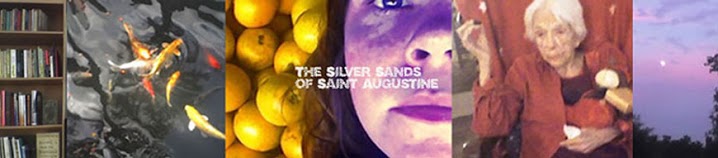
Dreamy Coy at the Lightner Museum

Dreamy Coy in Cool Water at the Lightner Museum

Those coy make me so calm. Just walk over the tiny bridge and look down. So many. Some look like Chinese paintings. Some are flaming red. Some are bright yellow. Some huge. Some small. Some beg for food. Looking into the cool blue. Witnessing the fluidity and winding movement through water. It puts my center right back to where it's supposed to be and fills me with the love of God.

Part of Me. Part of my Apartment.

Poem: "Mother Night" by Jim Harrison from Saving Daylight. © Copper Canyon Press, 2007. Reprinted with permission. (buy now)

Mother Night
When you wake at three AM you don't think
of your age or sex and rarely your name
or the plot of your life which has never
broken itself down into logical pieces.
At three AM you have the gift of incomprehension
wherein the galaxies make more sense
than your job or the government. Jesus at the well
with Mary Magdalene is much more vivid
than your car. You can clearly see the bear
climb to heaven on a golden rope in the children's
story no one ever wrote. Your childhood horse
named June still stomps the ground for an apple.
What is morning and what if it doesn't arrive?
One morning Mother dropped an egg and asked
me if God was the same species as we are?
Smear of light at five AM. Sound of Webber's
sheep flock and sandhill cranes across the road,
burble of irrigation ditch beneath my window.
She said, "Only lunatics save newspapers
and magazines," fried me two eggs, then said,
"If you want to understand mortality look at birds."
Blue moon, two full moons this month,
which I conclude are two full moons. In what
direction do the dead fly off the earth? Rising sun. A thousand blackbirds pronounce day.